


Hi reader, welcome back 👋. Today’s article is a collaboration with Paul Gantheil . I highly recommend you check him out. My favourite articles of his are here, here, and here.
Stock-based compensation (SBC) is widely known and yet seems to be consistently misreported and universally misunderstood, especially by the people who are most concerned, the owners of businesses.
Nowadays, it’s all too common for corporate financial reports to skew towards adjusted metrics. Often, these adjusted metrics obscure financial reality misleading investors.
Management will routinely add back SBC and this is often looked over by shareholders. They treat SBC as a benign, non-cash accounting entry that can be safely ignored.
But can it?
When we dig deeper it becomes unequivocally clear that treating SBC as “free money” is a dangerous illusion.
It is a tangible economic expense that, when abused, acts as a corrosive drag on long-term compounding.

“For example, managements sometimes assert that their company’s stock-based compensation shouldn’t be counted as an expense. (What else could it be – a gift from shareholders?)” – Warren Buffett
History
To understand the ubiquity of SBC today, we have to look back to the 1970s and 1980s.
The origins of equity compensation are deeply rooted in agency theory.
Corporate boards realized that a fundamental, structural conflict of interest existed between dispersed shareholders (the owners) and corporate managers (the agents hired to run the business).
Left to their own devices, managers might hoard excess cash, under-leverage the balance sheet to protect their jobs, or pursue aggressive, unprofitable empire-building acquisitions to boost their own prestige.
The solution? Give executives stock options. By tying executive wealth directly to long-term share price appreciation, boards attempted to create an ownership mentality.
In this original paradigm, SBC was a surgical tool applied sparingly.
The 1990s dot-com boom broke this paradigm. As hyper-growth technology startups flooded the market, they faced a dual dilemma: a severe scarcity of cash and a desperate need to secure highly specialized talent.
Lacking internally generated cash flows to pay market-clearing salaries to software engineers, these startups used their own equity as a parallel currency, effectively bartering future ownership claims in exchange for current labor.
This use of options as a compensation strategy was supercharged by a highly permissive regulatory environment.
Before 2005 accounting rules allowed companies to issue employee stock options without recording them as an expense on the income statement. This created a massive, artificial boost to reported earnings.
By the time mandatory expensing rules (ASC 718 - June 2005) were finally implemented, behaviours had permanently shifted.
SBC had evolved from a specialized executive alignment mechanism into the baseline compensation for employees in the startup economy.
SBC Through the Lifecycle
The economic justification for SBC is tightly linked to a firm’s position in the corporate lifecycle.
In the cash starved young growth phases, massive equity dilution is generally par for the course, as startups must issue equity and use SBC to survive.
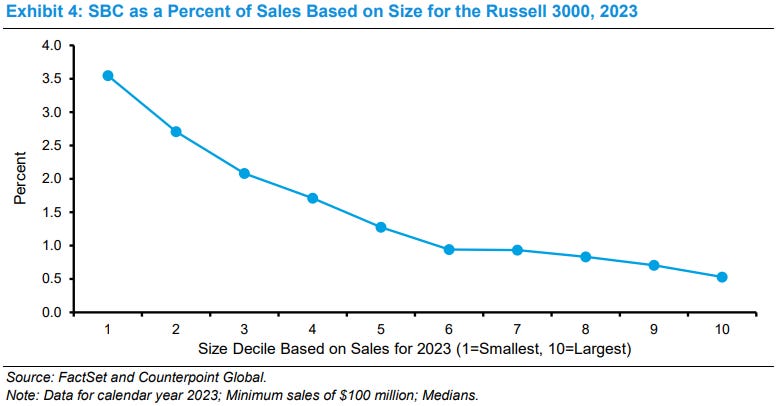
The hazard emerges when companies transition into maturity. As revenue growth decelerates and the firm begins generating significant free cash flow, the aggregate volume of SBC as a percentage of revenue should also structurally decline, as the company can now pay for its employees with cash.
This idea is academically backed. As shown in Exhibit 4, smaller companies exhibit higher SBC as a % of sales.
However, there exist exceptions in certain industries where even big companies depend on SBC to attract and retain the best talent.
For instance, despite being significant in size, fast growing SaaS companies or companies involved in the recent rise of AI depend on SBC as a form of enticing compensation.
The Illusion of Alignment
Although corporate boards defend broad-based SBC by arguing that it aligns employee incentives with shareholders, behavioral economics tells a much more nuanced story.
Organizational psychology splits motivation into two domains: intrinsic (deriving meaning, autonomy, and mastery from the work itself) and extrinsic (working primarily for financial rewards).
Empirical research proves that intrinsic motivation is a far superior predictor of sustained productivity and innovation.
While financial remuneration is necessary to prevent dissatisfaction, increasing equity packages does not directly increase output once a baseline perception of fairness is achieved.
Furthermore, the “ownership mentality” argument fails completely at the rank-and-file level due to the locus of control.
A mid-level software engineer has zero control over the macroeconomic variables, interest rates, and broad market sentiments that dictate short-term stock prices.
This creates an asymmetry in perceived value. Because employees are highly concentrated (their salary and equity are tied to one company) and face vesting risks, they apply steep, subjective discount rates to their unvested equity.
The company might expend an asset that costs shareholders $100 in dilution, but the employee only perceives its value as $70.
Ultimately, this means that stock options are not the panacea of alignment and motivation that boards believe them to be.
The Accounting Mirage
SBC mainly comes in two forms: stock options or Restricted Stock Units (RSUs).
Stock options give employees the right (but not the obligation) to buy shares in the company at a fixed price in the future. If the share price rises above that price, the option has value; if it doesn’t, the option expires worthless.
RSUs are a promise to give shares to the employee at a future date, provided certain conditions are met (usually staying in the company). For accounting purposes, RSUs are valued at the share price on the grant date and expensed over the vesting period (usually 4 years). However, the actual shares are delivered when the RSUs vest, at the share price at that time, which may be very different from the price used for accounting purposes.
When SBC is granted, no matter whether its stock options or RSUs, it is first expensed on the income statement.
Because issuing equity doesn’t immediately drain cash from the corporate treasury, GAAP rules mandate that the SBC expense must be added back to net income within the Cash Flow from Operations (CFO) section – in other words, it’s “non-cash”.
This practice has led to the idea that SBC is not a real cost to shareholders and can be ignored, leading to investors and companies adjusting metrics by adding back SBC.
The justification is that it’s “non-cash”, so it can be ignored. Or that you’re double counting if you expense it and then also take into account the dilution.
As Charlie Munger said; “that’s an insane argument to make”.
SBC is a very real cost to shareholders because firstly, it’s a form of compensation, but secondly, it increases the amount of shares outstanding which dilutes shareholders.
Dilution can be very nefarious to shareholders, especially if the company is growing fast, which is why many companies try to buy back shares to offset the dilution.
If the company automatically repurchases the same amount of shares created, then the dilution carried out through their SBC programs is offset.
In that case, owners are not diluted. So… its fine, right?
No.
The capital spent to offset the dilution is a drain on cash flow that is typically far more than what GAAP SBC expense may report.
However, not only does GAAP miss it, but also Wall Street analysts (unsurprisingly) with their adjusted modified rearranged calibrated earnings before interest tax depreciation amortization compensation and anything-else-that’s-inconvenient.
Let’s have a look at some examples.
The first will be a simple representation of how companies and analysts misreport the simple earnings metric.
The second will showcase how to go about finding the true cost of SBC when companies choose to buyback some shares to offset dilution.
SaaS Example
The easiest example to showcase misreporting is with Software-as-a-Service (SaaS) stocks.
These companies have been under the spotlight recently due to the “SaaSpocalypse”.
Following significant drawdowns – ranging from 20-30% to up to 70% – many investors are saying many companies are at bargain prices, or even priced for extinction.
Although we concur with most of the theses arguing that many of these companies have wide moats, and in all likelihood will be resilient to AI, we reserve different opinions with regards to the valuation of many of these companies.
It’s common practice for the earnings of these companies to be reported excluding SBC expense.
The argument is that the HUGE amount of SBC these companies carry out is a necessity to attract and retain the best talent, and that if everything goes to plan SBC will eventually decrease as a % of revenue and all will be well – a similar narrative to many fairytales.
Thus, it’s argued it’s more useful to look at their earnings and multiples excluding SBC.
For instance, a quick glance at the PE multiples of these companies on Bloomberg will have SBC excluded by default. The companies’ and Wall Street’s metrics will also have SBC excluded by default.
To showcase the difference it can make, the graph shown below shows the difference between the default EPS used in reporting results for these companies (red), and GAAP EPS (green) where most of the difference can be attributed to SBC expense.
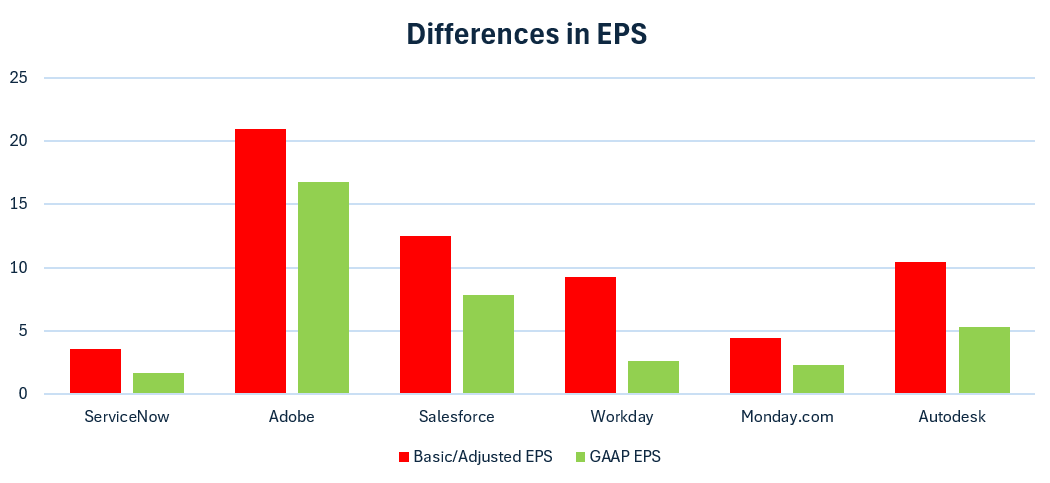
As shown, in many cases the difference in EPS is around 50%, and up to 70% in the case of Workday. This dramatically changes the P/E.
Firstly, like Buffett said, is SBC supposed to be a gift from shareholders?
Secondly, although we understand the argument, the premise relies on many IF’s. As intelligent investors, we believe it’s wiser to look at a company’s metrics for what they truly are.
Meta Platforms Example
Like many other companies, Meta repurchases shares to offset some of the dilution carried out.
As shown below, Meta has generally been decreasing total share count.
However, in 2025 it seems $26bn was spent on share repurchases, whilst share count only decreased 0.2%... how is that possible?
The reason is that most was spent offsetting dilution.
The line “Share-Based Compensation” is the SBC reported by GAAP.

Unfortunately, neither GAAP nor adjusted metrics accurately account for the true cash cost of SBC that companies like Meta have no choice but to spend on compensating their employees.
The true cost of SBC makes Meta go from a cash cow to being a cash burner.
Meta is known for being a cash cow, generating over $220bn FCF in the past 5 years.
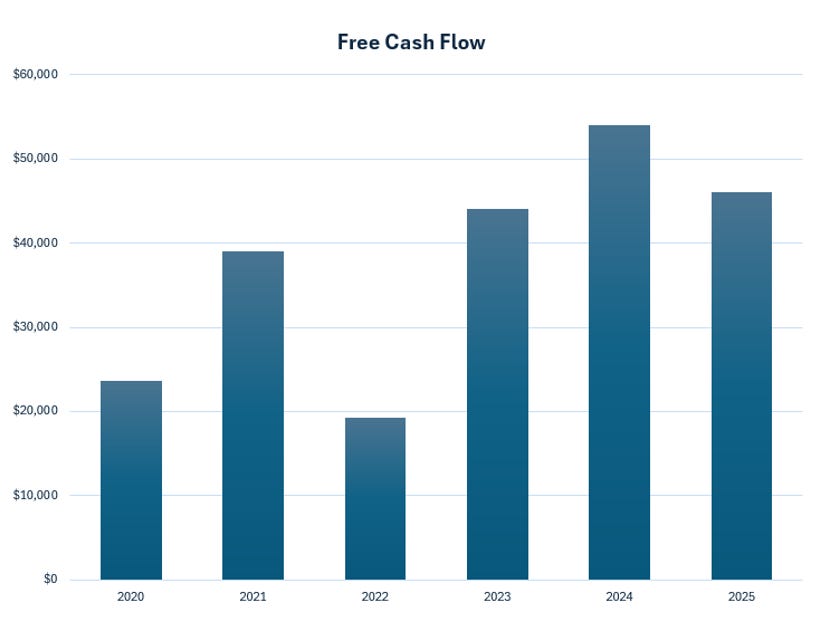
If you make the adjustment, Meta’s FCF goes from being nearly 50bn in 2025 to about 4bn.
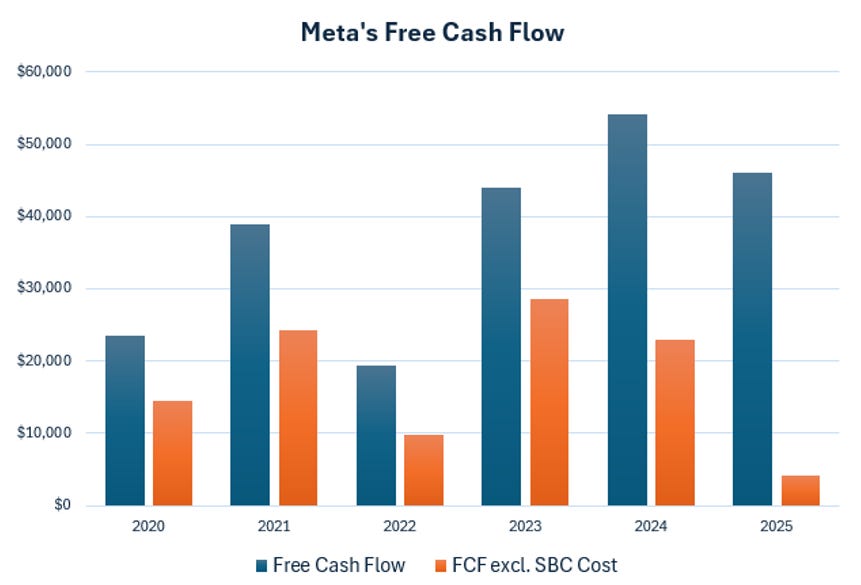
That doesn’t sound like a cash cow to us.
The true cost of stock-based compensation is the cash required to undo dilution through the shares that were bought back, plus any cash taxes that must be paid because compensation was delivered in stock.
And this means there can be a huge difference between the GAAP SBC cost reported, and the true cost to shareholders.
The main reason being that they tend to repurchase the shares after they’ve gone up in price.
As shown below, doing some simple maths we can reverse-engineer the avg. price (not an exact method) shares were repurchased at, and we can then find out how much can be attributed to offsetting dilution and how much was genuinely given back to shareholders.
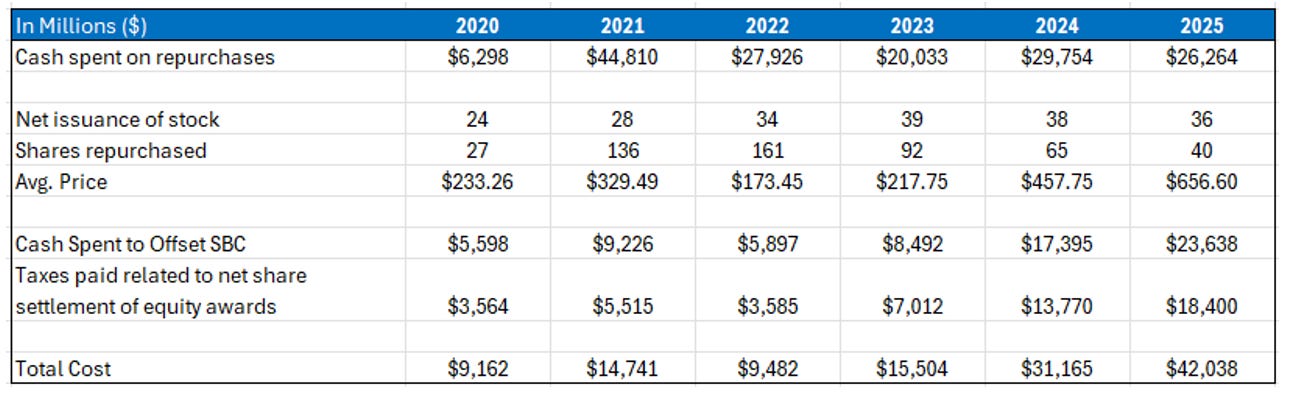
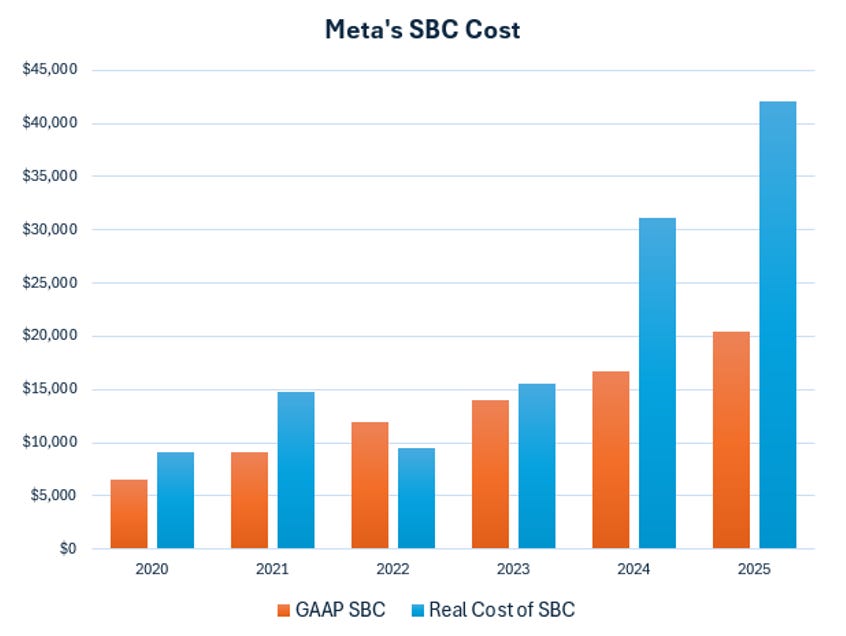
In 2025, we can see that the cost of the total SBC package was around $42bn, not the $20.4bn reported by GAAP.
Making this adjustment for Meta, the cost of SBC balloons, and in 2025 was more than double the amount reported by GAAP.
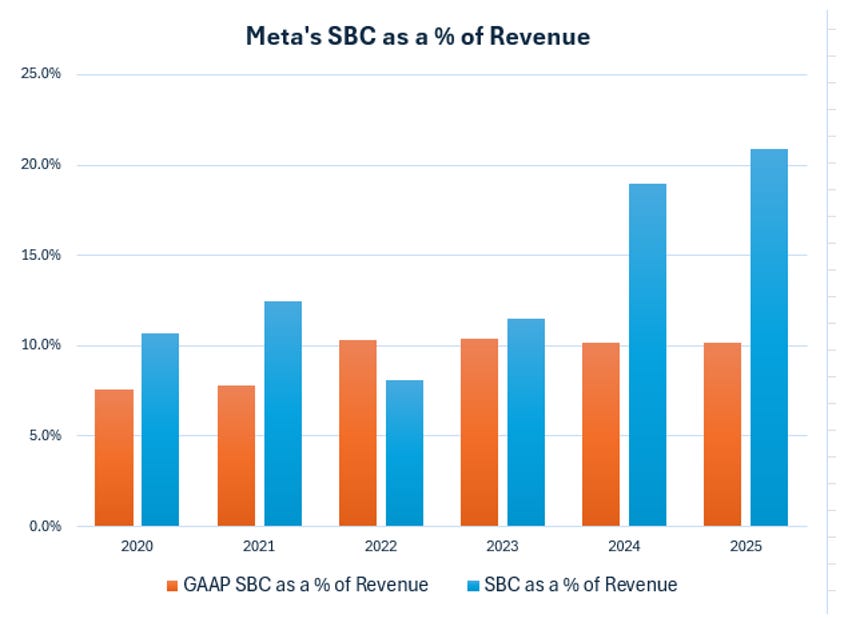
This brings Meta’s SBC as a % of revenue from 10% to more than 20%, which is a huge amount.
This turns what seemed like a 36x Price to FCF (TTM) to 400x P/FCF.
Is this a criticism at Meta for doing this? No.
This is simply a criticism towards the reporting methods.
We believe that as shareholders, we ought to make this adjustment to truly understand how our cash is being used – or at least be aware of it.
The cash leftover after this adjustment is truly what’s leftover and available to be distributed back to shareholders.
To sum up:
If you’re looking at a P/E multiple, make sure you understand how SBC is treated in the “E”. Too often SBC is removed, optically deflating the multiples.
If you’re wanting to calculate FCF or Owner’s Earnings there are three possible scenarios:
Scenario 1: No cash is spent on buybacks. There’s no buyback amount to adjust, however there are still tax withholding payments when RSUs vest, and those are real cash out the door. Thus, FCF adjustment is just the tax withholdings, and the full dilution shows up in the share count.
Scenario 2: Some dilution is offset like the Meta example. The cost is the buybacks to offset part of the dilution plus tax withholdings. The remaining unoffset dilution shows up in the share count.
Scenario 3: All dilution is offset. The cash cost is the buybacks plus tax withholdings. No dilution remains.
For a more in-depth discussion of the accounting implications, check out this podcast episode from James Emanuel with Professor Kevin Koharki.

The Intersection of ROIC and SBC
We’ve established that SBC is a real economic cost - to free cash flow, to earnings, to shareholders. How does it impact Return on Invested Capital (ROIC)?
If we use the standard Mauboussin Operating Approach to calculating ROIC, thankfully it does account for SBC. Because SBC is embedded in EBIT, as part of R&D and SG&A, it reduces operating income.
When those line items are then capitalized - as Mauboussin recommends for intangible-heavy businesses - the SBC-funded portions are capitalized alongside the cash-funded portions. These are then added back to the invested capital base.
Consider this hypothetical example. Company A and Company B both have the same sales, COGS, SG&A and R&D. However, Company A pays its employees 100% in cash, while Company B pays its employees a mixture of cash and SBC.
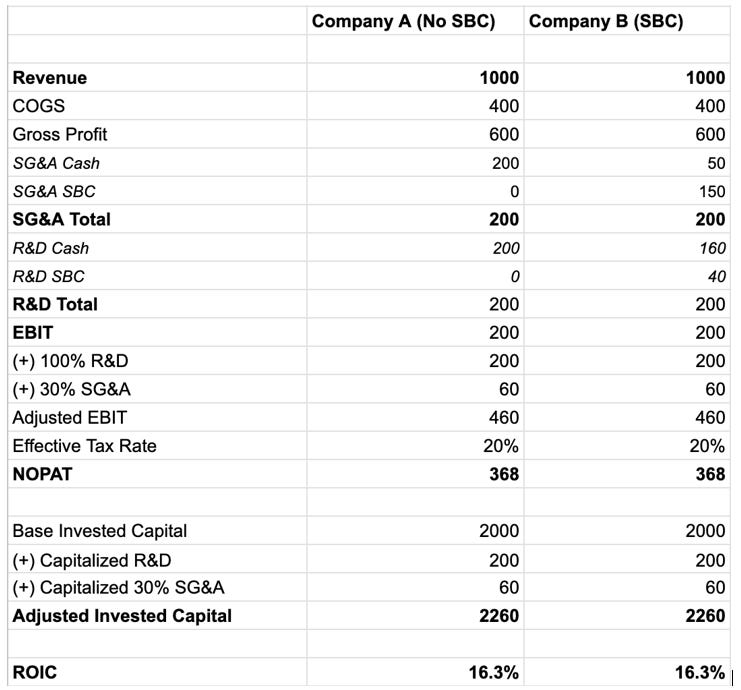
So long as the investor uses the Mauboussin operating method, ensuring SG&A and R&D are capitalized and added to the invested capital base, it nets out and ROIC is equivocal. In this framework, SBC-funded expenses are identical to cash-funded expenses when capitalized.
The free cash flow adjustments and share dilution problem then must be handled separately.
For investors seeking to understand the true capital efficiency of a business, recognizing how SBC flows through these calculations is essential.
Conclusion
Stock-based compensation is not an accounting footnote - it is a structural feature of modern corporate finance that touches all metrics investors rely on.
None of this is to say that SBC is inherently wrong. In the early stages of the corporate lifecycle, equity compensation is a rational and necessary tool.
However, when mature, cash-generative businesses continue to issue stock at startup-era rates, they are conducting a slow, silent wealth transfer from long-term shareholders to employees, often behind a wall of adjusted metrics.
The evidence presented follows a consistent pattern. SaaS companies report headline multiples that are optically deflated once adjusted for SBC. Meta’s cash cow status evaporates once the true cost of offsetting dilution is accounted for.
As shareholders, the adjustments are conceptually simple. Never accept an earnings or free cash flow figure that excludes SBC and ensure the ROIC properly capitalizes SG&A and R&D expenses.
When a company repurchases shares, determine how much of that buyback was spent treading water against dilution versus genuinely returning capital to owners.
The cost is real, the dilution is permanent, and the best defense is an unvarnished, open-eyed analysis.
The views expressed in this publication are our own and do not represent the views of any past or current employer. This content is for educational and informational purposes only, and is not intended as investment advice, a recommendation, or a solicitation to buy or sell any financial instruments. The Pursuit of Compounding holds shares in Meta Platforms Inc. Readers should conduct their own research or consult a licensed professional before making investment decisions.
Don't worry, be happy!
Seriously, I do struggle however -- in the case of restricted stock -- with GAAP accounting that requires that companies report earnings per share AFTER the expense of the RSUs AND with the additional shares in the denominator of the EPS calculation. That makes no sense at all, so no wonder every company out there talks about "adjusted earnings". Maybe the accounting profession should get their act together. Either deduct the grant as an expense and don't add the shares, or add the shares and exclude the grant expense?
This video with Professor Kevin Koharki, a PhD in financial statement accounting, breaks down the issues with stock based compensation with a step by step walkthrough of the numbers at META and Amazon: https://rockandturner.substack.com/p/the-dangerous-game-investors-are