

Hermès, founded in 1837 by Thierry Hermès, has evolved into a global symbol of ultra-luxury while remaining dedicated to its artisanal roots. The family-controlled company eschews mass-market scale in favor of meticulous craftsmanship, with categories spanning leather goods, saddlery, silk, ready-to-wear, and watches.
There are many great Hermès business write-ups on Substack, including this one from Daniel's Deep Dive, and this one from Best Anchor Stocks.
If you’d rather listen, there are some great podcasts about the company as well:
The company’s extraordinary brand equity is best understood through the lens of the 24 Anti-Laws of Luxury Marketing, popularized by Kapferer & Bastien in The Luxury Strategy: Break the Rules of Marketing to Build Luxury Brands.
Rather than following traditional corporate playbooks, Hermès deliberately rejects standard marketing techniques to elevate its desirability. For example, the brand fundamentally adheres to the principles of “not responding to rising demand” and “making it difficult for clients to buy” by strictly constraining the production volumes of its coveted Birkin and Kelly bags.
It operates under the premise that “luxury sets the price; price does not set luxury,” consistently raising prices over time to increase demand rather than lowering them to chase volume.
The adherence to these anti-laws provides the context for understanding how the company navigates the current macroeconomic environment, and will come into play as we discuss valuation at the end.
Q1 Results
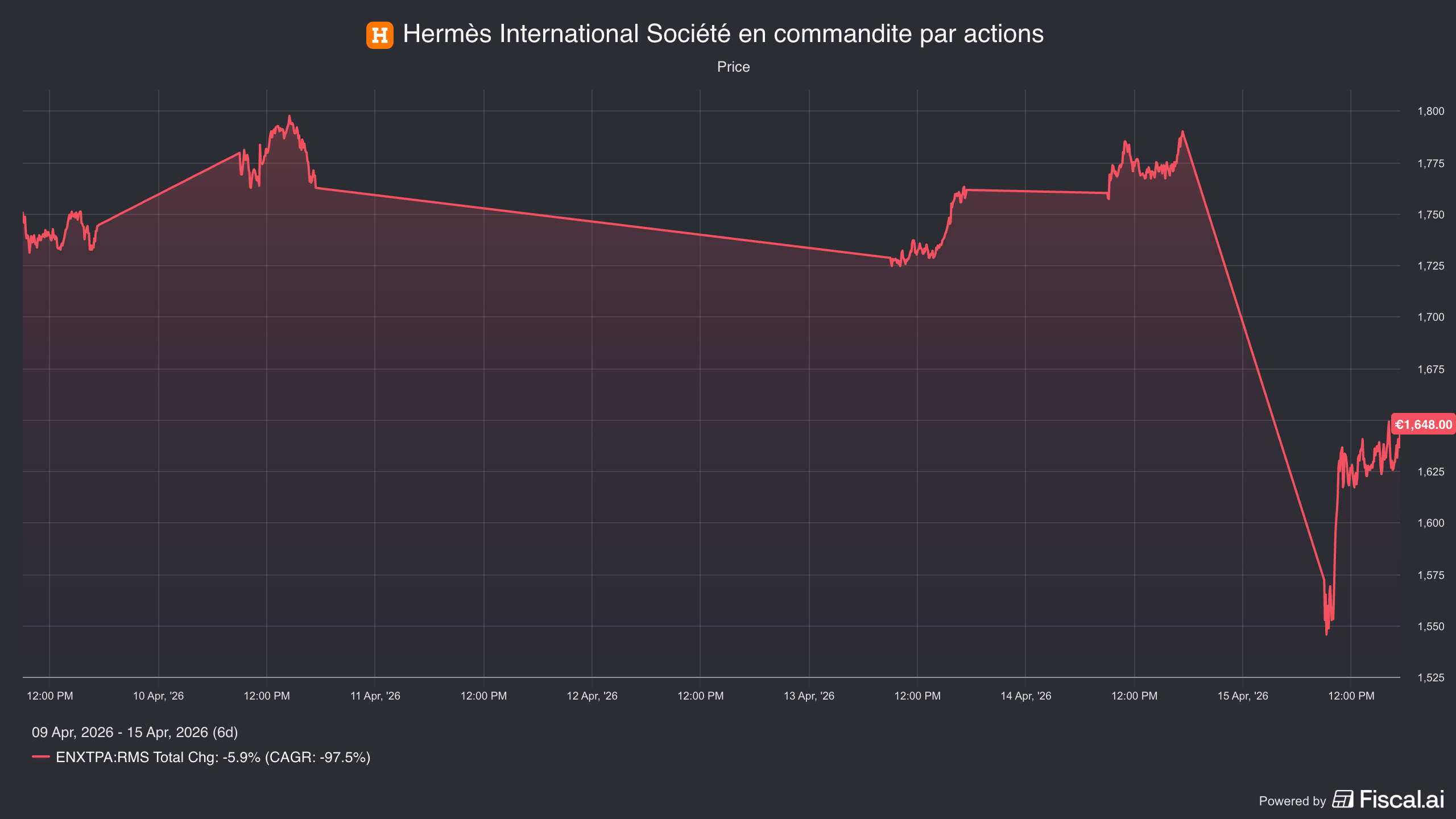
On April 15, the luxury sector experienced a significant jolt when Hermès released its results. The market reacted sharply, sending the share price down approximately 14% at one point, and wiping out nearly $20 billion in market capitalization.
This follows tepid LVMH and Kering results posted earlier in weak as well.
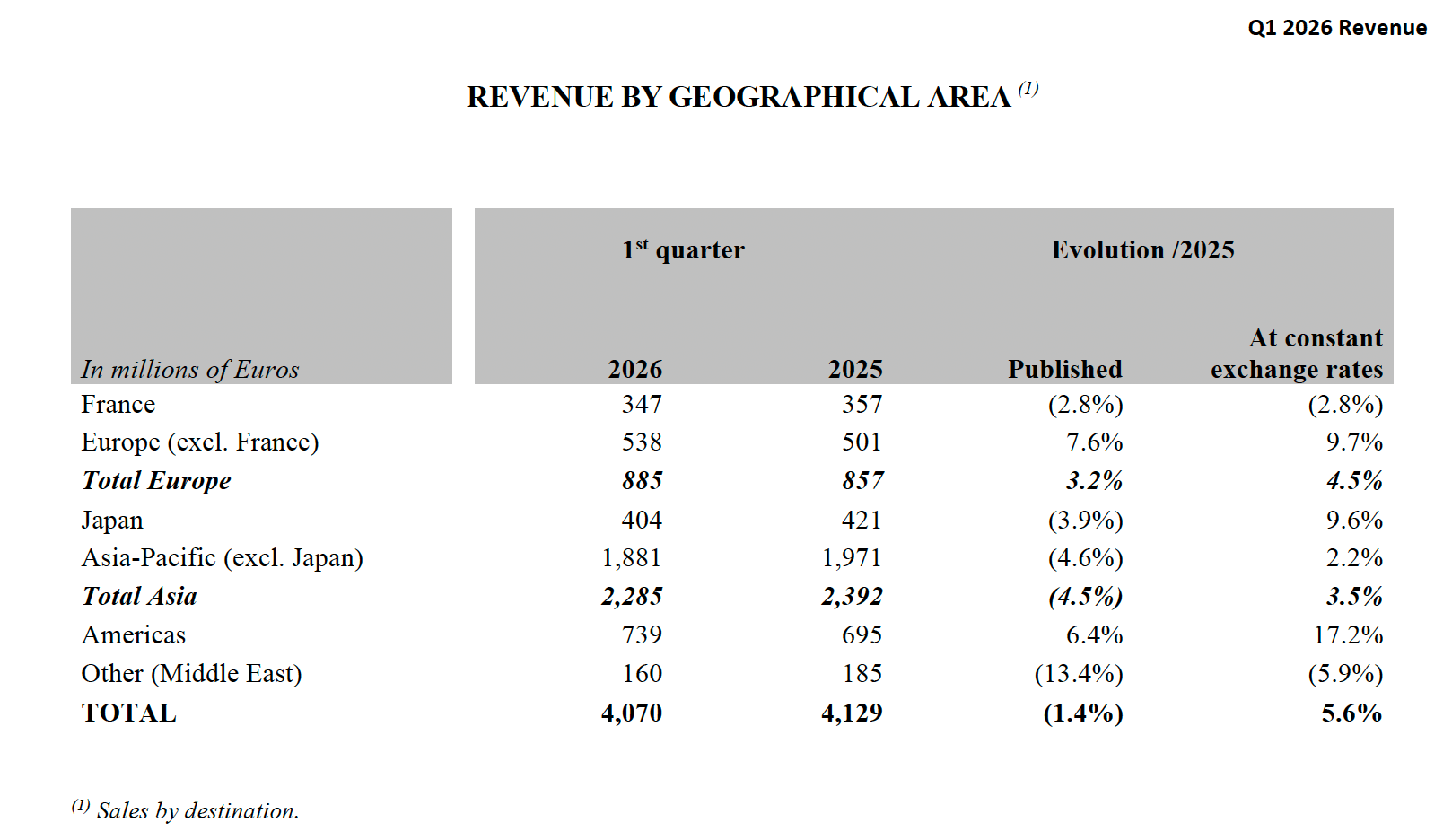
For the quarter, the company reported consolidated revenue of €4.07 billion. While this represents a 6% increase at constant exchange rates, the reported revenue actually contracted by 1% due to a €290 million foreign exchange headwind. More importantly for market expectations, the 6% organic growth fell short of the ~7% consensus.
What happened?
Middle East Disruptions
A primary factor in the Q1 revenue miss was the escalation of the conflict in the Middle East, which negatively impacted global travel retail. The “Other” geographic segment, which primarily encompasses the Middle East, contracted by 6% at constant currency (a 13.4% decline on a published basis).
“What you need to bear in mind is that for January and February, we had great double-digit growth, which was very homogenous across these 2 months. It’s only in March that the revenue started to go down.
...we estimate that the impact for the group will be 1.5% for the group for Q1. So the 7% I mentioned earlier should have been 8.5% if we hadn’t had these developments in the Middle East.” - Executive Vice President of Finance Eric du Halgouët, Q1 2026 Conference Call
Hermès has six boutiques in the Middle East. With no localized e-commerce presence in the region, the drop in physical traffic immediately impacted the top line.
This disruption cascaded into the global wholesale segment (down 7%), heavily influenced by lower sales in airport concessions. Management estimated that without the Middle East conflict, global organic retail growth would have been 8.5% instead of the reported 7%, representing a direct 150 basis point headwind to the quarter.
Polarization in Demand
The quarter highlighted divergent trends across key global markets, reflecting a polarized luxury consumer base.
The standout performer was the Americas, posting 17.2% growth at constant currency to reach €739 million. This performance indicates that demand among U.S. ultra-high-net-worth individuals remains highly resilient, even as the broader aspirational luxury market cools due to inflation and interest rates.
Asia-Pacific (ex-Japan) sharply stepped down from the 8% growth seen in Q4 2025. While Q1 faced a tough year-over-year comparison against a strong 2025 Lunar New Year, the underlying Chinese macroeconomic environment (marked by a property crisis and weak consumer confidence) presents an ongoing challenge.
Meanwhile, Japan maintained a steady 9.6% organic growth rate, while Europe (excluding France) delivered 9.7% organic growth, driven by local domestic demand. France, however, contracted by 2.8% on a published basis, directly impacted by the lack of international tourist flows to Paris.
Sector Performance and Pricing Dynamics
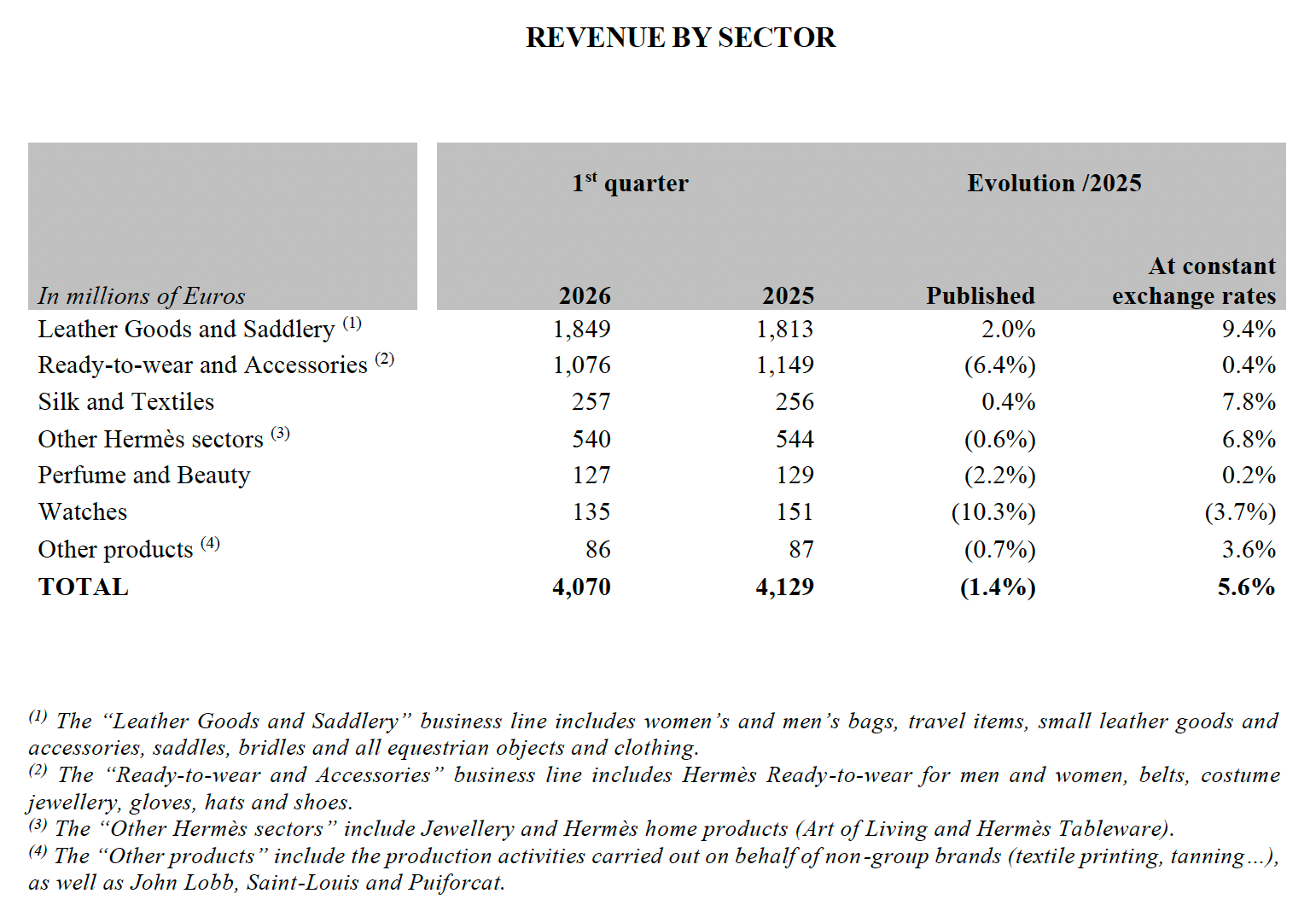
Hermès’s Leather Goods and Saddlery division - the core of the business that makes up nearly half of total revenue -grew 9.4% at constant currency. Unlike traditional consumer brands, Hermès’s volume growth is strictly constrained by its artisanal production model, typically expanding volumes by a planned 6% to 7% annually as new workshops open (such as the newly inaugurated 25th workshop in Loupes).
Because volume is capped, revenue growth is also supported by pricing adjustments (pricing power). In January 2026, Hermès implemented significant price increases. For example, the standard Birkin 25 (Togo leather) in the U.S. increased by 6.3% to $13,500, while the Mini Kelly 20 (Epsom) jumped 8.6% to $11,400. While these hikes protect margins against inflation, some market analysts are questioning whether top-line growth is becoming overly reliant on pricing rather than volume expansion across all product categories.
Management would counter that volume expansion is antithetical to maintaining the prestige of the Hermès brand, and based on the anti-laws of luxury we’d agree.
"As we always say, we remain true to our principle of passing through our input costs as little as possible... And our conclusion is that it's really the quality of the collections, the colors, the formats that really make a difference. And we don't see any issues pertaining to price increases right now” - Executive Vice President of Finance Eric du Halgouët Q1 2026 Conference Call
Other divisions saw mixed results: Silk and Textiles grew organically by 8%, but the Watches segment contracted by 4% organically, reflecting a broader industry-wide slowdown.
Financials and Corporate Governance
Financially, Hermès maintains a conservative balance sheet. At the end of 2025, the company reported cash of over €12billion. This cash pile allows the company to self-fund capital expenditures without the need external debt.
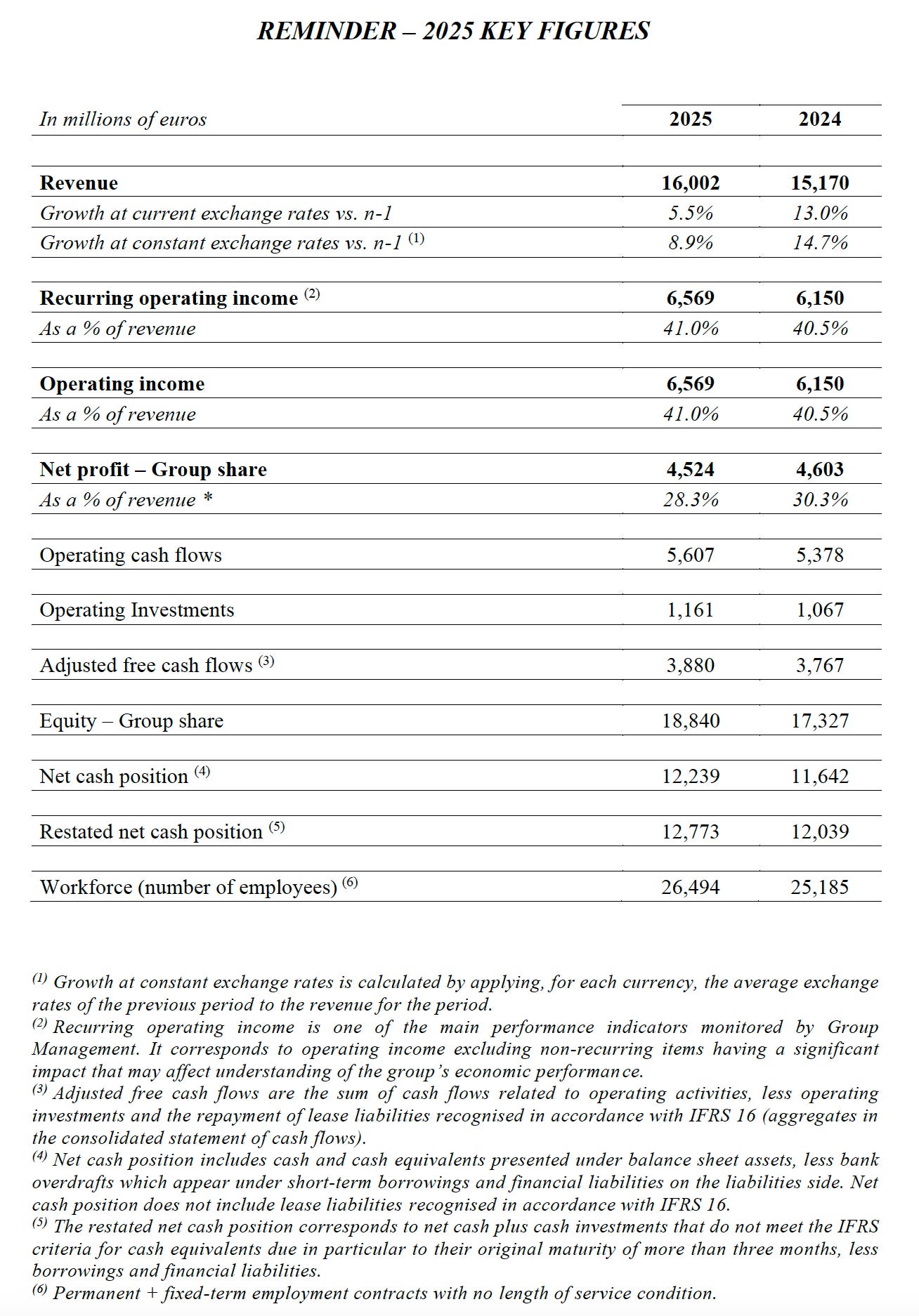
Buybacks will never be a material part of shareholder returns, as the company wants to preserve a very specific ownership structure. Further, the founding family members prefer dividends (presumably to fund living expenses) and so Hermès generally pays out all excess cash via a dividend.
The company has proposed an ordinary dividend of €18.00 per share for the 2025 fiscal year.
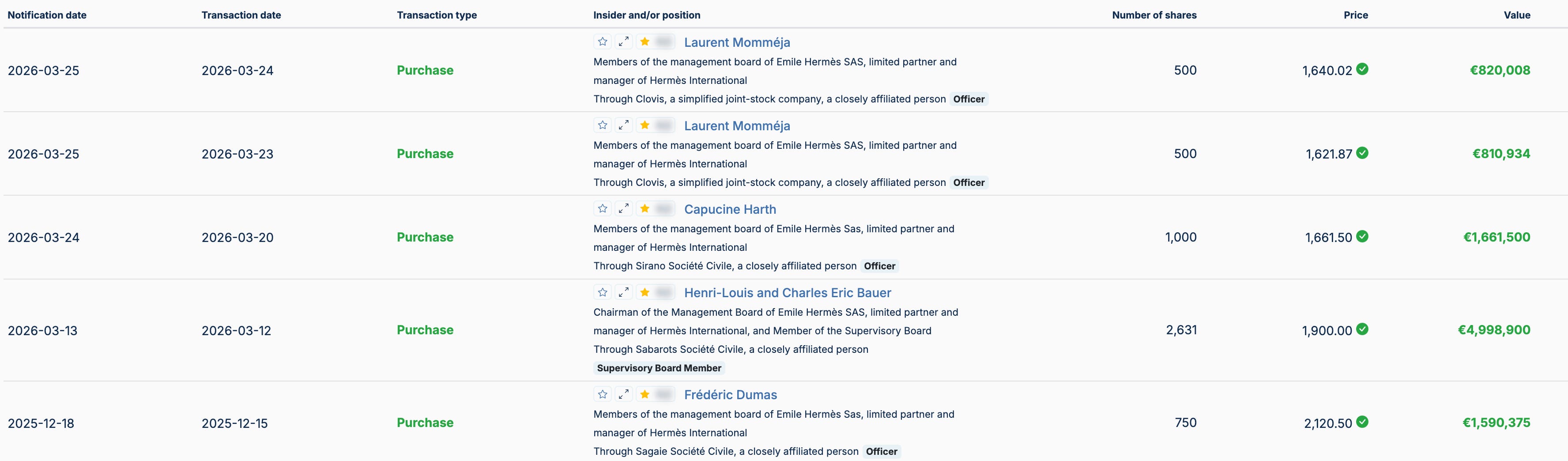
On the governance front, the company’s structure remains fortified by the H51 holding company, which pools 50.2% of family shares to prevent hostile takeovers. With the share price weakness in March 2026 insiders were also accumulating shares between €1620 and €1900, spending a total of about €9 million.
The company has also faced recent headline noise regarding fifth-generation heir Nicolas Puech, whose 5.8% stake (valued at roughly €14 billion) has allegedly vanished, leading to ongoing legal disputes. For those interested in going down this scintillating rabbit-hole, The Economist published a great read in December 2025.

Valuation: The Market’s Debate
Following the Q1 report and subsequent sell-off, Hermès’s valuation has become a more passionate debate.
Some analysts are reduced their EBIT estimates, pointing out that growth is currently heavily reliant on handbag pricing. As ancillary volume slows, and the Chinese consumer slowdown may be structural rather than cyclical, and the stock is ripe for a multiple contraction.
Conversely, others have upgraded the stock, viewing the 150 basis point Middle East drag as a transient, geopolitical issue. Bulls argue the sell-off is a mechanical derating that offers a rare entry point into a company with unmatched pricing power, high ROIC, and absolute supply constraints.
We’ll take a different approach, and instead ask: What is priced in?
We’ll use our Price Implied Expectations (PIE) model that was introduced in The Consilient Investor 03.

The Inputs
Rather than asking “what is Hermès worth?” the PIE model asks what set of future operating results would justify today’s share price.
Our key assumptions:
Base revenue: €16.0 billion (2025 actual)
Revenue growth: 10% tapering to 6% by year 16
Operating margin: holding at ~41% (consistent with the 2023–2025 average)
Incremental investment rate: ~20% of NOPAT reinvested, reflecting the capital-light artisanal model
Cost of capital: 8.7%, calculated
Tax rate: 28.56%
With these inputs, the model produces an output price of approximately €1,636, roughly in line with where the stock is trading post-selloff.
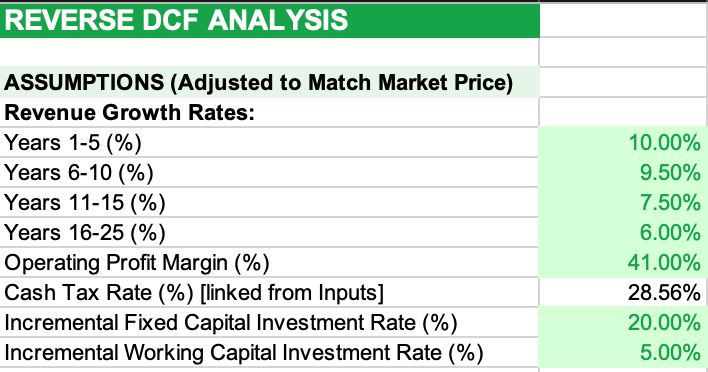
The wonderful thing about the model is that the user can input their own assumptions to see where the share price lands.
Interpreting the MIFP
The Market Implied Forecast Period (MIFP) comes out at approximately 24 years. In PIE terms, that means the market is pricing Hermès to earn returns above its cost of capital for 24 more years before fading to economic neutrality. Said another way, the market is pricing the brand equity and moat to only last to 2050.
Is 24 years a lot or a little? Context matters:
For a typical S&P 500 constituent, MIFPs tend to cluster in the 7-15 year range.
For other high-quality compounders, MIFPs have landed in the 15–20 year range.
Hermès is a 189-year-old company whose core product (the Birkin) was introduced in 1984 and has appreciated in both cultural cachet and retail price in every year since.
Interestingly, there is evidence that, up to 2015, the Birkin itself has outperformed the S&P 500.
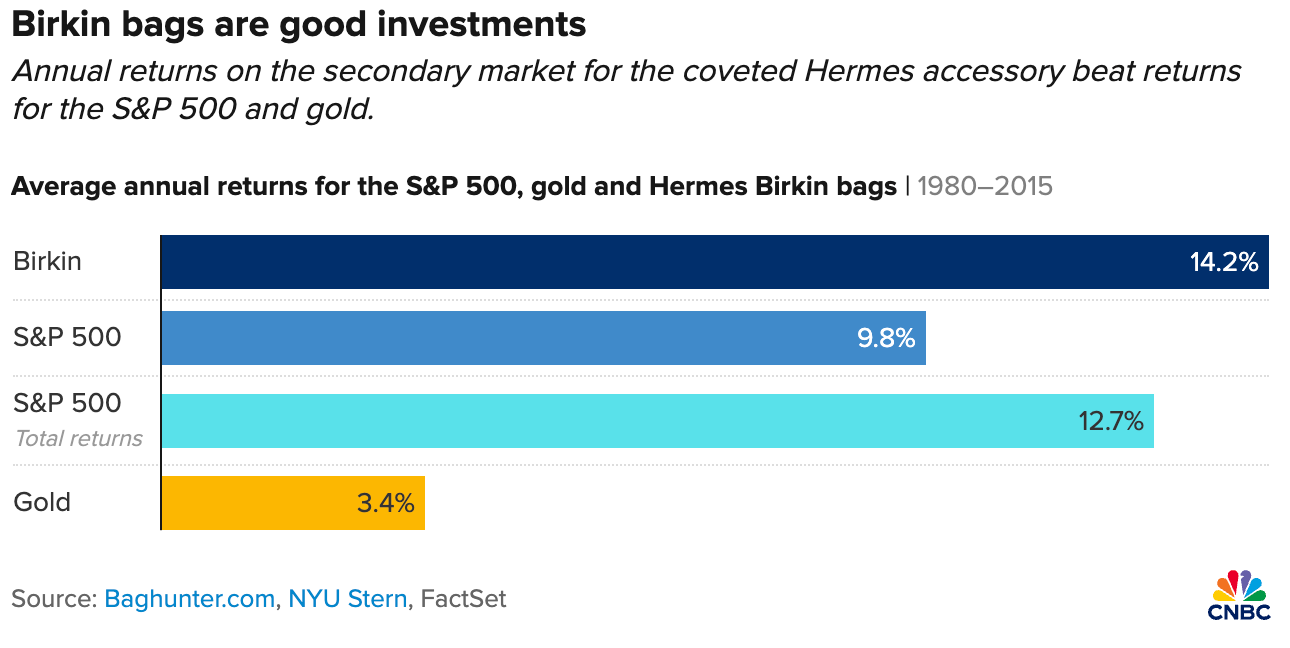
Viewed this way, a 24-year MIFP is likely a gross under-appreciation for the intangible assets that Hermès has built. Given the structural scarcity model, the insider ownership, and family control, it’s likely to last far longer.
The Durability of Constant Growth
If instead we flatten our revenue assumptions to a constant 8% annual growth and hold everything else equal, the model spits out the same rough endpoint. The MIFP does extend though, to 25+ years.
This means that today’s price is consistent with Hermès compounding revenue at high single digits for a very long time. It’s a strong statement about the durability the market is underwriting, and it’s the single assumption most worth stress-testing as an investor.
The Hermès financial model will be available at the end of the article for paid subscribers to download.
Summary
Hermès’s Q1 2026 results present a nuanced picture. The company’s unique artisanal model, massive net cash position, and pricing power remain fully intact. However, the deceleration in China and the acute sensitivity to geopolitical shocks demonstrate that even the most exclusive luxury brands are not entirely immune to cycles.
As the overall luxury sector transitions into a normalized growth phase, the market is actively recalibrating the premium it is willing to pay for seemingly timeless companies like Hermès.
Insiders certainly like shares at €1900 or less. Ultimately, the decision to invest at today’s prices depends on the investors conviction about the MIFP:
If Hermès products will remain desirable beyond 2050 and the company can sustain ~8% revenue growth through that period, then today is a fair price. It’s certainly not a screaming bargain, but rather a reasonable entry point into an exceptionally high quality business.
If the Middle East weakness drags on, or Chinese demand is structurally impaired, the stock is still moderately expensive even after the selloff.
If growth can accelerate and the MIFP extends meaningfully beyond 24 years, then the shares today are undervalued.
Q1 2026 certainly had many moving parts. However, strip those away and you find a business still growing organically, still raising prices without resistance, and still sitting on €12 billion in cash.
The selloff repriced the stock for a more uncertain world, and whether it overshot is a question of how durable the investor believes Hermès to be.
Disclaimer: We are private investors and not financial advisors. This post is for educational purposes only and does not constitute financial advice. The Pursuit of Compounding owns shares in Hermès via the US ADR HESAY. Always conduct your own due diligence before making any investment decisions.