
Beyond the Spreadsheet: 10 Lessons from Brookfield Asset Management's New CEO
Connor Teskey on Culture, Risk, and Decisive Capital Allocation

Enduring firms stand out because of their roots: culture, operational discipline, and a clear mindset toward risk. In our 2025 Brookfield Corporation Deep Dive, we dug into those foundational elements, exploring the firm's Patient Capital philosophy, its accounting complexities, and the corporate cultural infrastructure that has driven a 19% CAGR over 30 years.

Recently, we got another view into the cultural infrastructure that drives the business performance and the numbers.
In a March 2026 episode of Farnam Street’s The Knowledge Project, Connor Teskey - who was named CEO of Brookfield Asset Management in February 2026, succeeding Bruce Flatt - pulled back the curtain on exactly that.
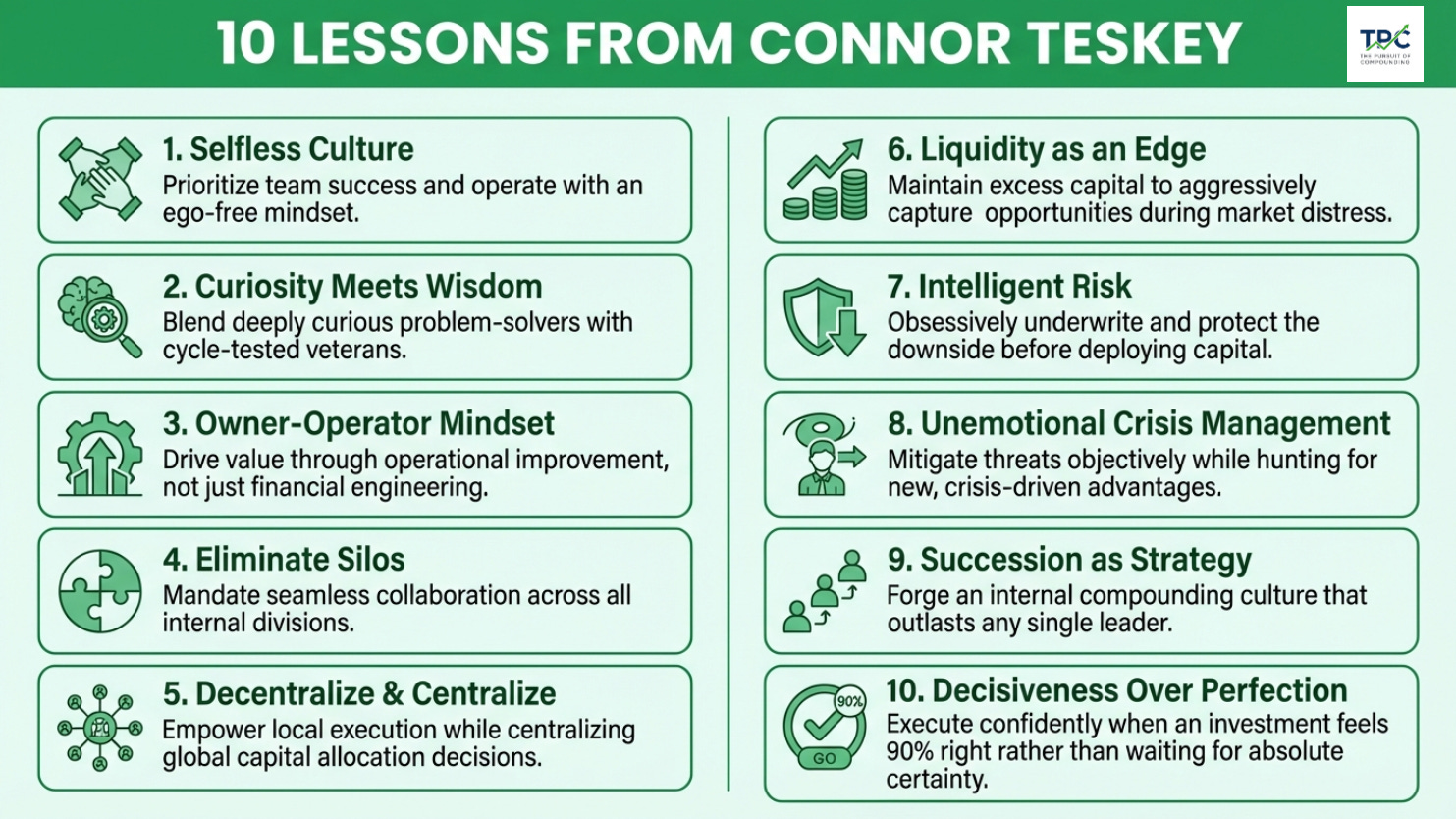
Whether your AUM is $100 or $1 trillion, every investor can learn from this conversation. Here are our 10 most powerful takeaways for investing, business, and life.
1. Selfless Corporate Culture
Brookfield’s immense scale is often highlighted, but Teskey emphasizes that their culture is their true foundation. The firm operates with a distinct, ego-free mindset, as leaders focus on putting others in a position to succeed rather than taking the credit for themselves. Building a firm where senior management measures their success by the achievements of their team ensures sustainable, multi-generational growth.
“It doesn't matter how talented someone is, they're not more talented than the entire team of people you can put around them. Therefore, having people that are exceptionally good at different aspects of the job, but equally can work with others... those are the people that succeed the most.”
2. Pair the Intellectually Curious with the Wise
“We like people who are almost kind of nerdy. And I don’t mean they’re nerdy in that they aren’t enjoyable to hang out with... but they’re intellectually curious in that they like to look at a hard problem that other people have struggled to solve, and they’re willing to kind of roll up their sleeves and put in the hard work to try and solve it to generate an outsized positive outcome.”
When hiring, Brookfield discards traditional central casting. They look for individuals who are deeply intellectually curious and willing to roll up their sleeves to solve the hard, complex problems that others avoid. Operating as a strict meritocracy allows them to elevate exceptional young talent early, giving them massive responsibility based purely on their value-add rather than their tenure.
Brookfield then mixes its young, energetic talent with experienced veterans who have the scar tissue of living through multiple market cycles. This intergenerational talent blend protects the firm from historical blind spots while maintaining energy.
3. The “Owner-Operator” Mindset Matters
Most asset managers are financial sponsors - they acquire a business, optimize the capital structure, and wait for multiple expansion or a favourable exit. Brookfield operates from fundamentally different DNA. Rooted in its 100-year history as an industrial conglomerate that directly operated businesses, the firm treats operational improvement as a core component of every return thesis, not a bonus.
“There’s not an investment around the world today where operational improvement doesn’t form part of our return bridge.”
For investors, this distinction matters. An owner-operator creates value that persists regardless of market conditions or exit timing. A financial sponsor is ultimately dependent on the market to deliver returns. As we noted in our Deep Dive, this mindset is what underpins Brookfield’s Ecosystem - the internal information network where operational intelligence flows across verticals, turning each acquisition into a source of proprietary knowledge that improves the next one.
4. Actively Eliminate Silos
“… we really encourage collaboration such that when the firm has an opportunity, it doesn’t matter what someone’s title is... there really are no walls at Brookfield.”
Despite spanning incredibly diverse and sometimes non-overlapping verticals, such as infrastructure, real estate, renewable power, and private equity, Brookfield operates without internal walls.
They actively mandate collaboration. If a private equity professional has expertise that can add value to an infrastructure deal, they are instantly looped in. Your title and division matter far less than the value you can bring to the firm’s overall mission.
But operating without walls doesn't mean operating without structure.
5. Pair Centralized Capital Allocation with Decentralized Execution
“We raise capital from the largest pools of money around the world and deploy it into the largest investment themes globally.”
Managing a trillion dollars across multiple countries creates an organizational problem: how do you maintain local expertise without losing strategic coherence?
Brookfield’s answer is a deliberate structural tension between decentralization and centralization.
On the ground, regional investment and operating teams are given autonomy. They source deals, manage assets, and build the relationships that surface unseen opportunities. A team in Mumbai knows what infrastructure India needs in ways that a desk in New York never could. A team in São Paulo understands Brazilian regulatory dynamics that would take an outsider years to learn.
However, every final capital deployment decision flows to a small, centralized investment committee. This is where Brookfield’s scale becomes a genuine edge rather than a burden - leadership can sit with a pipeline of opportunities from dozens of countries and compare risk-adjusted returns on a truly global basis. A dollar earmarked for a European wind farm competes directly against a data centre in Texas or a toll road in India.
The result is a firm that acts locally while allocating globally, ensuring that capital always flows to its highest and best use.
6. Liquidity is a Competitive Advantage
“Liquidity is this funny thing which is, every time it’s overvalued when you don’t need it, and it’s incredibly undervalued when you do need it. And therefore we like to prudently finance all of our businesses, but we always like to ensure that we have some excess capital for something unforeseen.”
Many investors optimize for maximum leverage to juice near-term returns, but Brookfield views excess capital as a strategic weapon. Maintaining dry powder and utilizing non-recourse, asset-level financing ensures survival during severe downturns and enables the firm to aggressively scoop up distressed opportunities when competitors are paralyzed.
"Having access to capital when others don't has proven valuable across asset classes, geography, and cycles."
7. The Intelligent Bearing of Risk
"We focus a huge amount of time, the vast majority of the discussion, will be focused on the downside. We like to believe that if you buy high-quality businesses in good markets that have strong downside protection, if you underwrite the worst-case scenario really, really well, the base case or the expected case will end up being very attractive.
…
“If you wait to try and de-risk everything to the absolute nth degree, amazing, you'll de-risk your transactions... you'll also do none of them.”
Brookfield is perfectly comfortable taking on risk to generate returns, although they actively seek to de-risk as much as possible.
An Excel spreadsheet can model a hundred scenarios, but it can create an illusion of certainty that doesn’t exist. The variables you can’t model - management quality, regulatory shifts, geopolitical disruption - are often the ones that matter most.
Before putting capital to work, they focus on isolating and locking in the four sources of development risk: construction costs, long-term contracted revenues, engineering/procurement contracts, and financing. By securing these upfront, Brookfield ensures that external macroeconomic variables like unexpected interest rate hikes or power price fluctuations become irrelevant.
Survival is the only road to riches. Let me say that again: Survival is the only road to riches. You should try to maximize return only if losses would not threaten your survival and if you have a compelling future need for the extra gains you might earn. - Peter L. Bernstein, Against the Gods: The Remarkable Story of Risk (1996)
When you boil it all down, it's the investor's job to intelligently bear risk for profit. Doing it well is what separates the best from the rest." - Howard Marks
8. Be Forward-Looking and Manage Crises Unemotionally
"When markets move negatively... we don't spend the first 30 minutes of a 60-minute conversation discussing the negative impact on what we have. We spend all 60 minutes saying one, how can we mitigate, protect, ensure that the value of what we have is preserved, but then how can we look to capitalize or capture on the opportunities that this crisis or this downturn may have created."
Crisis management is a defining trait of great capital allocators. When the inevitable turbulence arises, conversations immediately turn to two unemotional, forward-looking questions: How do we mitigate downside to protect value? And, crucially, what new asymmetric opportunities has this crisis just created for us?
9. Succession-as-a-Strategy: The Flatt-to-Teskey Transition
In our Brookfield Deep Dive, we flagged key person risk with Bruce Flatt as one of the primary investment risks for BN shareholders. Flatt is the architect who transformed a sprawling Canadian conglomerate called Brascan into a trillion-dollar global real asset powerhouse.
So, when Flatt stepped aside and Teskey was named CEO at 38, it was the single most important leadership transition in the firm’s modern history. Moreover, Teskey doesn’t mark the end of the Flatt era; he’s a product of it.
"The culture is what will ensure we can keep growing and building the way Bruce has built the firm."
He was shaped by Brookfield’s own intergenerational talent pipeline, rose through the meritocracy the firm prizes, and absorbed the Patient Capital mindset by operating within it for his entire career.
For long-term Brookfield shareholders, this is the most tangible evidence yet that the compounding engine can outlast any single leader.
10. Decisiveness Over Perfection
We’ll wrap with one of the most pragmatic decision-making frameworks in the interview:
"When something feels 90% right, you do that transaction. Do 10 of them, and you'll be right nine times out of 10."
This is a progression of the risk framework outlined in lesson #7.
If the underwriting process obsessively protects the downside, then the remaining uncertainty isn't a reason to hesitate. Nothing will be 100% certain - in investing, uncertainty is the price of admission.
Because time in is more important than timing, compounding favours the decisive allocator - the one who deploys capital consistently into attractive opportunities rather than waiting for a certainty, which may never arrive.
For the individual investor, this is liberating. It means that the goal isn’t to find the single flawless investment or to perfectly tick the bottom. Instead, the goal is to develop a repeatable process, apply it rigorously, and execute when the evidence is overwhelmingly in your favour.
Final Thoughts
Brookfield’s playbook reads less like a set of investment principles and more like a philosophy of organizational life. Culture over ego. Curiosity over credentials. Liquidity over leverage. Downside before upside.
This is exactly what draws us to it, and why it constitutes a large position in our portfolio.
As Teskey talks about downside protection, liquidity as a competitive advantage, and about protecting against development risk before deploying capital, we hear Flatt’s ideas, expressed through a new voice. The culture isn’t dependent on one person; it was built to outlast any single leader.
For long-term Brookfield shareholders, this is arguably the most important takeaway from the entire interview. The key person risk we identified in the Deep Dive isn’t eliminated, but it is substantially de-risked. The principles, the culture, and the decision-making framework have been successfully transmitted to the next generation of leadership. Brookfield has shown it can compound more than just capital - it has compounded its own institutional wisdom.
These lessons are applicable to all, regardless of the AUM. The same principles that let Brookfield thrive across a century of market cycles are available to anyone willing to adopt them - stay intellectually curious, protect your downside obsessively, keep dry powder for when others panic, and act when a decision feels 90% right.
A better spreadsheet isn’t the answer. The edge is in everything the spreadsheet can’t capture.
Like Podcasts? Check out my recent conversation with René Sellmann

Looking for a new read instead? Explore the full library of deep dives and investment insights below 📈

Disclaimer: We are private investors and not financial advisors. This post is for educational purposes only and does not constitute financial advice. Brookfield Corporation (BN) and Brookfield Asset Management (BAM) are stocks we currently own. Always conduct your own due diligence before making any investment decisions.
It was a great read! thanks for posting this one!